
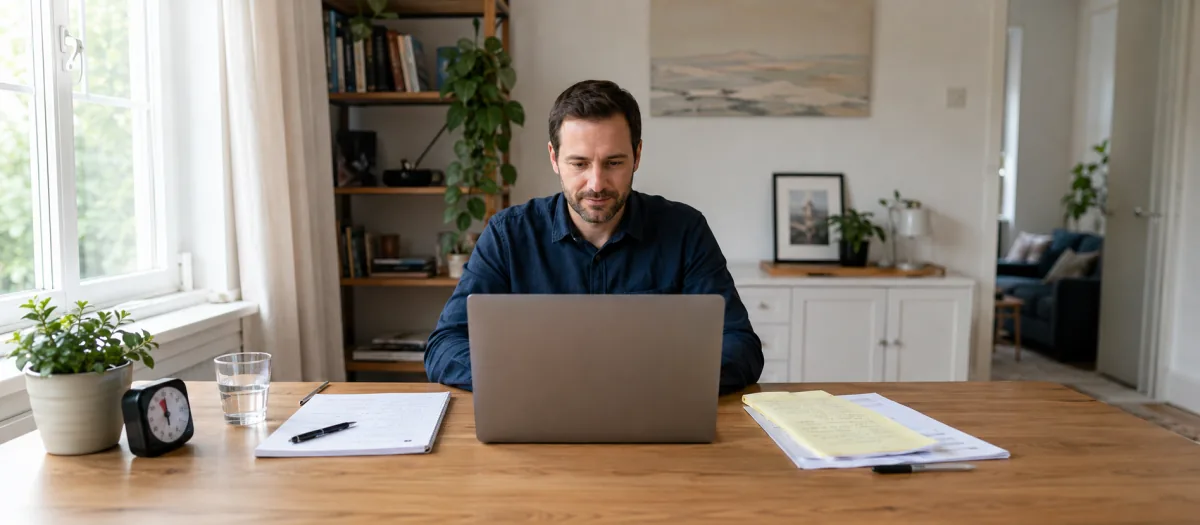
If you are applying for a graduate program or a high-volume role in Australia, there is a good chance your first "interview" will not involve a person at all. The big four banks, the Big 4 consulting firms, large retailers, and a number of government graduate streams now use one-way and AI-driven video interviews to screen the first round. You record answers to set questions on your own time, a timer counting down, and software (often HireVue or similar) does the first sort. Turn up unprepared for that format and you can be filtered out before a human ever sees your name.
We have looked at how these systems work and where candidates trip up, and pulled it into a straightforward guide.
What an AI-Driven Interview Actually Is
There are two flavours, and it helps to know which you are facing:
- One-way (asynchronous) video: you record responses to pre-set questions with no live interviewer. A recruiter, sometimes assisted by AI scoring, reviews them later. This is the most common format in Australian graduate hiring.
- Conversational AI: a voice or text system asks questions and responds in real time, sometimes with follow-ups based on your answers.
A quick myth-buster on the "AI reads your face" fear: HireVue, the most widely used platform, publicly dropped facial analysis back in 2020, saying it added little. Current scoring leans on the content of your answers, transcribed from your speech, and sometimes delivery signals like pace and filler words. And because these systems capture and store your recording, they fall under Australia's Privacy Act 1988, so a legitimate employer should tell you how your data is handled.
What These Systems Are Looking For
- Relevance: are you using the vocabulary, skills, and context the role calls for?
- Structure: the STAR method (Situation, Task, Action, Result) is still the gold standard for behavioural answers, and it scores cleanly.
- Delivery signals: heavy "um", "uh", and "like" can weigh against a fluency score.
- Role keywords: terms specific to the job ("CI/CD pipeline", "stakeholder management", "clinical governance") lift relevance.
- Completeness: thin or vague answers score low even when they sound fine to a human ear.
Why Strong Candidates Still Fail
The usual reason is not weak experience, it is a mismatch in how the answer is communicated. Experienced people often score poorly because they:
- Ramble. These systems reward tight, organised answers, not meandering ones.
- Miss the keywords. They describe real work but never use the language from the job ad.
- Rush or mumble. Poor audio and a breakneck pace introduce transcription errors that quietly cost you.
- Skip the numbers. "I led a project" scores below "I led a cross-functional team of 8 that delivered a A$2M product relaunch three weeks early."
7 Strategies to Handle an AI Interview
1. Decode the Job Ad First
Spend 20 minutes pulling the exact language out of the ad: the verbs ("led", "optimised", "scaled"), the tools, the outcomes. Work those terms naturally into your answers. The system is looking for genuine alignment, not copied phrases.
Tip: StrongHire's AI Resume Checker flags which keywords from an ad you are currently missing.
2. Make STAR Automatic
STAR is your highest-leverage prep for scored interviews:
- Situation: set the scene in a sentence or two.
- Task: your specific responsibility.
- Action: exactly what you did (first person, "I").
- Result: quantify it wherever you can.
Rehearse until it feels natural. StrongHire's Mock Interview tool lets you record, get AI scoring, and tighten your structure first.
3. Sort Your Setup
Audio quality matters more than people expect, because everything you say gets transcribed. Before you start:
- Quiet room, windows shut.
- A headset or external mic, not the laptop's built-in one.
- Stable internet (run a quick speed test).
- Soft light in front of you, not behind.
- Water within reach, a dry throat means more filler words.
4. Steady Your Pace
For clean transcription and confident scoring, aim for roughly 130 to 160 words per minute, a touch slower than fast conversation. Time yourself on a few practice questions. Consistently under 130? Lift it a little. Over 170? Slow down and breathe.
5. Lead With Your Best Point
Openings and closings tend to carry extra weight, just as they do with human interviewers. Do not bury your best line.
Instead of: "We had a challenging project... eventually, after months of work, I reduced costs by 30%."
Try: "I cut operating costs by 30%, about A$180,000 a year, by redesigning our vendor contract process. Here's how..."
6. Practise With Real Feedback
Reading tips helps; doing reps changes things. Practise with a tool that gives you AI feedback so the format stops feeling foreign. StrongHire's Mock Interview tool simulates these scenarios across software engineering, marketing, finance, and more, with instant scoring and transcript analysis.
7. Use the Final Question Well
Many of these interviews end with an open "anything else you'd like to add?" prompt. Most candidates waste it. Use it to reinforce your main strength, mention a relevant win you did not get to, and show genuine enthusiasm for the role.
Before and After
Weak answer (unstructured)
"In my last job I worked on a lot of different projects and I kind of managed the team and yeah we hit our goals most of the time. It was a pretty good experience."
The problems: no numbers, lots of hedging ("kind of", "pretty"), no STAR, no keywords.
Strong answer (STAR plus keywords)
"As a Product Manager, I was tasked with pulling back a customer churn rate that had climbed to 18%. I ran a data-driven retention push, built a cohort analysis model and A/B tested three new onboarding flows. Within 90 days we cut churn by 6 percentage points and lifted 30-day retention by 22%."
The wins: clean STAR, specific metrics, real product keywords, confident delivery.
Key Takeaways
- One-way and AI video interviews are now standard in Australian graduate and high-volume hiring.
- They score structure, keywords, quantification, and audio quality, not just "what you say".
- STAR is your best preparation tool.
- Sort your audio before every recording.
- Practise with real feedback, lead with your strongest point, and quantify everything.
These formats are not a wall in front of your career. They reward candidates who prepare deliberately, which levels the field for anyone willing to put the reps in.
Ready to practise? Try StrongHire's free Mock Interview tool and get AI feedback on your answers today.