
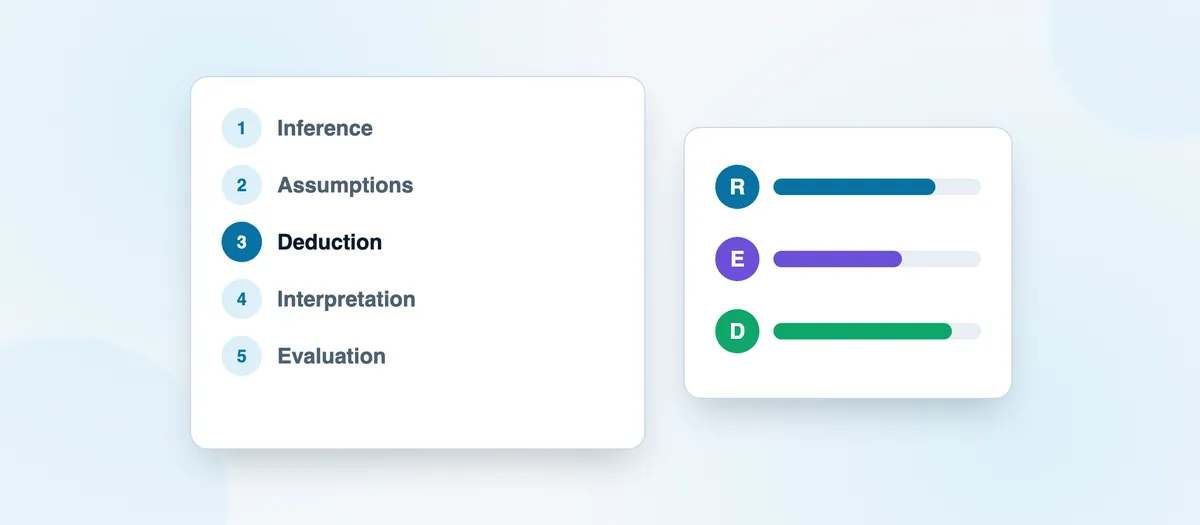
TL;DR: The Watson-Glaser, published by TalentLens, is a critical thinking test of 40 items taking about 30 minutes. It has five sections: inference, recognising assumptions, deduction, interpretation and evaluating arguments, reported as three sub-scores: Recognise Assumptions, Evaluate Arguments and Draw Conclusions. Each section has its own rules, and most lost marks come from applying the wrong rule or bringing in outside knowledge.
Critical thinking tests feel unfamiliar because they are not about maths or vocabulary. They test whether you can separate what is stated from what is assumed, and what follows from what merely sounds plausible. The Watson-Glaser is the best-known of them, and once you understand how each section is marked, it becomes far more manageable.
What the Watson-Glaser Is
According to TalentLens, the publisher:
- The test has 40 items and takes about 30 minutes. Practice-test publisher Practice Aptitude Tests documents the current Watson-Glaser III split as 12 items each on recognising assumptions and evaluating arguments, 6 on interpretation, and 5 each on inference and deduction.
- It measures five components: drawing inferences, recognising assumptions, deducing, interpreting and evaluating arguments.
- Results are reported as percentile scores on three areas, the RED model: Recognise Assumptions, Evaluate Arguments and Draw Conclusions.
- It is delivered online with item-banked questions, which means different candidates can see different questions, so memorising a question set will not help.
TalentLens positions the test for the recruitment and development of graduates, managers and professionals. It is best known as a law firm screen: UK firms have long used it to shortlist applicants for training contracts. If your invitation names the Watson-Glaser or TalentLens, this is the test you will sit.
The Five Sections, One at a Time
1. Inference
You are given a set of facts and a proposed inference. You judge it on a five-point scale: True, Probably true, More information needed, Probably false or False.
Illustrative example. The facts: a regional library opened on Sundays from March, weekday visits stayed about the same, total weekly visits rose by 12 per cent, and most Sunday visitors work full time on weekdays. The inference: "Many Sunday visitors could not easily visit during the week."
The answer is Probably true. The facts point strongly that way but do not prove it.
Tip: use "Probably true" or "Probably false" only when a specific fact clearly leans one way. If nothing points either way, the answer is "More information needed".
2. Recognising assumptions
You are given a statement, often a plan or a claim, and a proposed assumption. Decide whether the speaker is taking it for granted: Assumption made or Assumption not made.
Illustrative example. "We should move the team meeting to Wednesday afternoon so more people can attend." Proposed assumption: "More people are available on Wednesday afternoons."
Assumption made. The plan only makes sense if that is true.
Tip: an assumption is something the statement needs. Watch for words like "only", "all" and "always" in proposed assumptions; a plan usually needs a factor to be one cause, not the only cause.
3. Deduction
You are given premises to accept as true, even if they seem unrealistic, and a conclusion. Decide whether it follows or does not follow.
Illustrative example. "All graduates in the program rotate through finance. Some graduates rotate overseas." Conclusion: "Everyone who rotates through finance is a graduate."
Does not follow. All graduates rotate through finance, but nothing says only graduates do.
Tip: this is pure logic. Ignore what you know about the real world and test only whether the conclusion must be true if the premises are.
4. Interpretation
You are given a short passage to accept as true and a conclusion. Decide whether the conclusion follows beyond reasonable doubt.
Illustrative example. A company surveyed all 400 staff and 320 responded; 240 respondents said a new system was easier to use. Conclusion: "Three quarters of the company's staff find the new system easier."
Does not follow. Three quarters of respondents said so, but 240 is only 60 per cent of all staff, and the 80 non-respondents could think anything.
Tip: check the base of every figure. Many wrong conclusions quietly switch from "those who responded" to "everyone".
5. Evaluating arguments
You are given a question, usually about a policy, and an argument for or against it. Decide whether it is Strong or Weak.
Illustrative example. "Should employers pay for graduates' professional qualifications?" Argument: "No, because some qualifications have exams."
Weak. Having exams has nothing to do with whether an employer should pay.
Tip: a strong argument is both important and directly related to the question. An argument can be true and still weak if it is trivial or off the point. Judge relevance, not whether you agree.
The Mistakes That Cost the Most Marks
- Bringing in outside knowledge, especially in deduction and interpretation, where only the given information counts.
- Overusing "Probably true" in the inference section when the facts do not clearly lean either way.
- Confusing "one cause" with "the only cause" in the assumptions section.
- Judging arguments by whether you agree rather than by importance and relevance.
- Losing track of the base of percentages and survey figures in interpretation.
How to Prepare
- Learn each section's rule before you practise. The five sections are marked differently, and applying the wrong rule is the biggest single source of error.
- Practise section by section, then mixed. Build accuracy on one rule at a time, then practise switching between them at test pace.
- Review the reasoning, not just the answer. For every miss, identify which rule you broke.
- Work at about 45 seconds per item. With 40 items in about 30 minutes, steady pacing matters more than perfection on any one question.
Frequently Asked Questions (FAQ)
Q: How many questions are in the Watson-Glaser test?
A: TalentLens describes the Watson-Glaser as having 40 items, completed in about 30 minutes.
Q: What are the five sections of the Watson-Glaser test?
A: Inference, recognising assumptions, deduction, interpretation and evaluating arguments.
Q: What is the RED model?
A: The three areas Watson-Glaser results are reported on: Recognise Assumptions, Evaluate Arguments and Draw Conclusions.
Q: Do you need legal knowledge for the Watson-Glaser?
A: No. It tests reasoning, not knowledge of the law, and the instructions require you to work only from the information given.
Q: Which employers use the Watson-Glaser?
A: TalentLens markets it for recruiting graduates, managers and professionals, and it is best known in legal recruitment, where UK law firms have long used it to shortlist training contract applicants. Your invitation will name the test if you are asked to sit it.
Conclusion
The Watson-Glaser rewards precision. Learn the rule for each of the five sections, work only from the information given, and practise switching between sections at test pace.
Practise all five sections. StrongHire Labs' Critical Thinking practice covers inferences, assumptions, deductions, interpretation and evaluating arguments, with standard and hard sets, timed exam mode, and an explanation for every statement.