
TL;DR: After you submit a graduate application in Australia, the next step is usually an online assessment: timed aptitude tests (numerical, verbal, abstract or critical thinking), often alongside situational judgement and personality questions. They are built to measure how you reason, not what you studied, so the biggest gains come from knowing each format and practising under time pressure before the real thing.
Most graduate programs get far more applications than they can interview, so they screen with online tests first. It is a stage many candidates walk into cold, and it is also one of the most preparable parts of the process. This guide explains where the online assessment sits, the test types you are likely to meet, the companies behind them, and how to prepare.
Where the Online Assessment Sits in the Process
The Australian Government Graduate Program (AGGP) publishes its process, which makes it a useful reference point. The 2025 Generalist Stream candidate guide set out four stages:
- Online application: a written response about your motivation, your resume and your academic transcript.
- Online assessment: for shortlisted candidates, an assessment "designed to identify and measure key capabilities and attributes for an Australian Public Service graduate", taking about 45 minutes, with the recommendation to complete it in one sitting.
- Assessment centre: a virtual assessment centre with activities such as a panel interview, an individual presentation, a written task and a group activity.
- Matching and offers: successful candidates go into a merit pool and are matched with agencies.
Private sector programs differ in the detail, and some add a one-way video interview, but the shape is similar: an application, then online testing, then an interview or assessment centre. The online assessment is the gate between your application and a conversation with a person.
The Test Types You Are Likely to Meet
Australian careers guides such as GradConnection describe the same families of graduate tests: numerical reasoning, verbal reasoning, abstract or logical reasoning, personality questionnaires, situational judgement questions, and behavioural or emotional intelligence style assessments. Here is what each one asks of you.
Numerical reasoning
You answer questions from short word problems, tables and charts: percentages, ratios, rates, averages and comparisons. The maths rarely goes beyond high school level. What makes it hard is the clock and the distractors: the wrong options are often the answers you get from a common slip, such as taking a percentage of the wrong base or rounding too early.
Variants you may meet include data interpretation (several questions from one table or chart), number series (find the next number in a pattern) and speed arithmetic (many quick calculations against a tight clock).
Verbal reasoning
You read a short passage and decide whether each statement is True, False or Cannot say. SHL, a major test publisher, uses this format in its verbal reasoning examples: True if the statement follows from the passage, False if it is contradicted, and Cannot say if you cannot tell without more information.
The most common mistake is using outside knowledge. A statement can be true in the real world and still be "Cannot say" if the passage does not support it.
Abstract reasoning
You see a sequence or grid of shapes and choose what comes next, or what fills the gap. There are no words or numbers to lean on, so these tests measure how quickly you spot rules such as rotation, movement, counting or alternation, often several rules at once.
Critical thinking
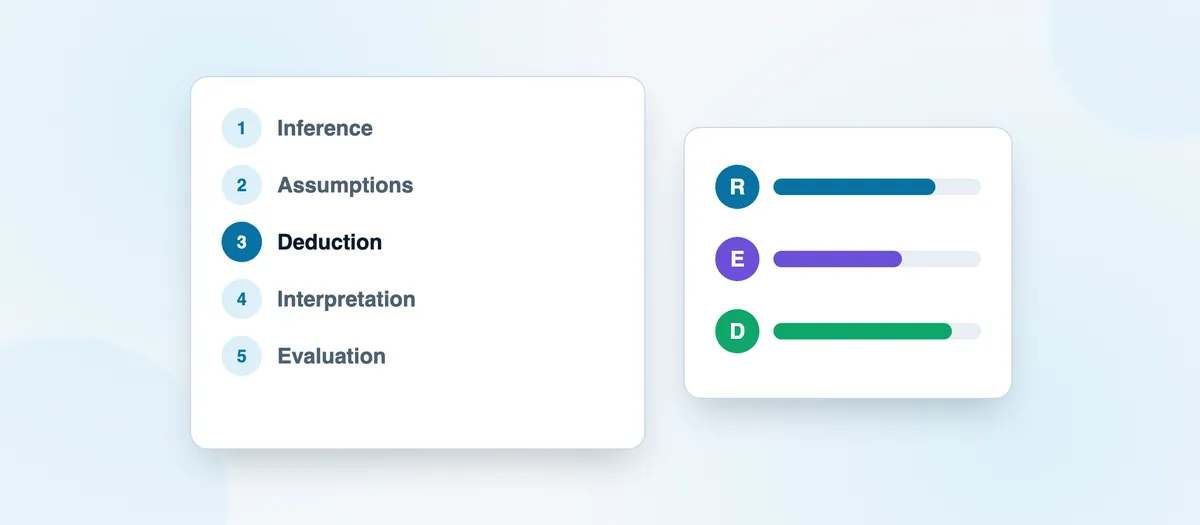
Critical thinking tests ask you to evaluate arguments and evidence. The best known is the Watson-Glaser, published by TalentLens, which has 40 items, takes about 30 minutes, and covers five areas: drawing inferences, recognising assumptions, deducing, interpreting and evaluating arguments. We cover it in detail in our Watson-Glaser guide.
Situational judgement
You read a workplace scenario and judge how effective a set of possible responses would be. There is no single right answer in the everyday sense; your judgements are compared with how experienced people in the role rate them. See our guide to situational judgement tests.
Personality and game-based assessments
Personality questionnaires ask how you typically behave and are not timed against a right answer. Some employers also use game-based assessments, which measure cognitive ability through short games. Criteria, for example, lists Cognify, a 15-minute game-based assessment of cognitive ability, in its assessment guide.
Who Publishes the Tests
Graduate employers rarely build their own tests. They license them from specialist publishers, and knowing the publisher tells you a lot about the format. Names you will see in Australia include:
- SHL: publisher of the widely used Verify ability tests, including the True, False, Cannot say verbal format.
- TalentLens: publisher of the Watson-Glaser critical thinking test, used in graduate, managerial and professional recruitment.
- Criteria: a US publisher that acquired the Brisbane-founded Revelian in March 2020. Its Criteria Cognitive Aptitude Test (CCAT) has 50 questions in 15 minutes and reports sub-scores for verbal ability, maths and logic, and spatial reasoning.
Your invitation email usually names the platform. If it does, look up that publisher's own sample questions, since they show the exact layout.
Practice Mode Versus the Real Thing
Real tests are timed, and many do not let you go back once you move on. Some numerical tests also ask you to type the answer rather than choose from options. When you practise, do some of each:
- Untimed practice to learn the methods and understand every mistake.
- Timed runs at the real pace, so the clock stops being a shock.
- No-going-back runs for formats that lock each answer, so you practise committing.
How to Prepare Without Guessing
- Learn each format before test day. Most lost marks come from not knowing the rules: Cannot say in verbal tests, or what counts as an assumption in critical thinking.
- Practise under the real time limits. Speed comes from familiarity, not from rushing.
- Review every mistake by type. If you keep taking percentages of the wrong number, that is one fix, not twenty separate errors.
- Estimate first on numerical questions. A quick estimate rules out options that are an order of magnitude off.
- Set up properly. GradConnection's advice is practical: check timing and deadlines, test your technology, find a quiet space, and avoid rushing at the last minute.
- Answer personality questions honestly. They look for consistency, and second-guessing an "ideal" profile tends to backfire.
Frequently Asked Questions (FAQ)
Q: What is a graduate online assessment?
A: A set of timed online tests that graduate employers use to shortlist applicants after the application stage, usually covering numerical, verbal, abstract or critical reasoning, often with situational judgement and personality questions.
Q: How long does a graduate online assessment take?
A: It varies by employer and publisher. The 2025 Australian Government Graduate Program Generalist Stream described its online assessment as taking about 45 minutes. Individual tests are often much shorter; Criteria's CCAT, for example, is 50 questions in 15 minutes.
Q: Can you prepare for aptitude tests?
A: Yes. The reasoning ability being measured changes slowly, but familiarity with the formats, the time pressure and the common traps improves how well your score reflects that ability.
Q: What does Cannot say mean in a verbal reasoning test?
A: That the passage does not give you enough information to decide whether the statement is true or false, even if it might be true in real life.
Q: Do Australian Government graduate programs use online tests?
A: The Australian Government Graduate Program's Generalist Stream has included an online assessment stage between the application and the assessment centre.
Conclusion
The online assessment rewards preparation more than almost any other stage of graduate recruitment. Learn the formats, practise at the real pace, and fix your mistakes by type, and your score will reflect what you can actually do.
Practise the same formats free. StrongHire Labs' Aptitude Tests cover problem solving, data interpretation, number patterns, speed maths, abstract reasoning, verbal reasoning and critical thinking, in practice and timed exam modes. Numerical and abstract questions are new every attempt, verbal items come from a reviewed bank that shows you unseen ones first, and every question comes with its worked answer.